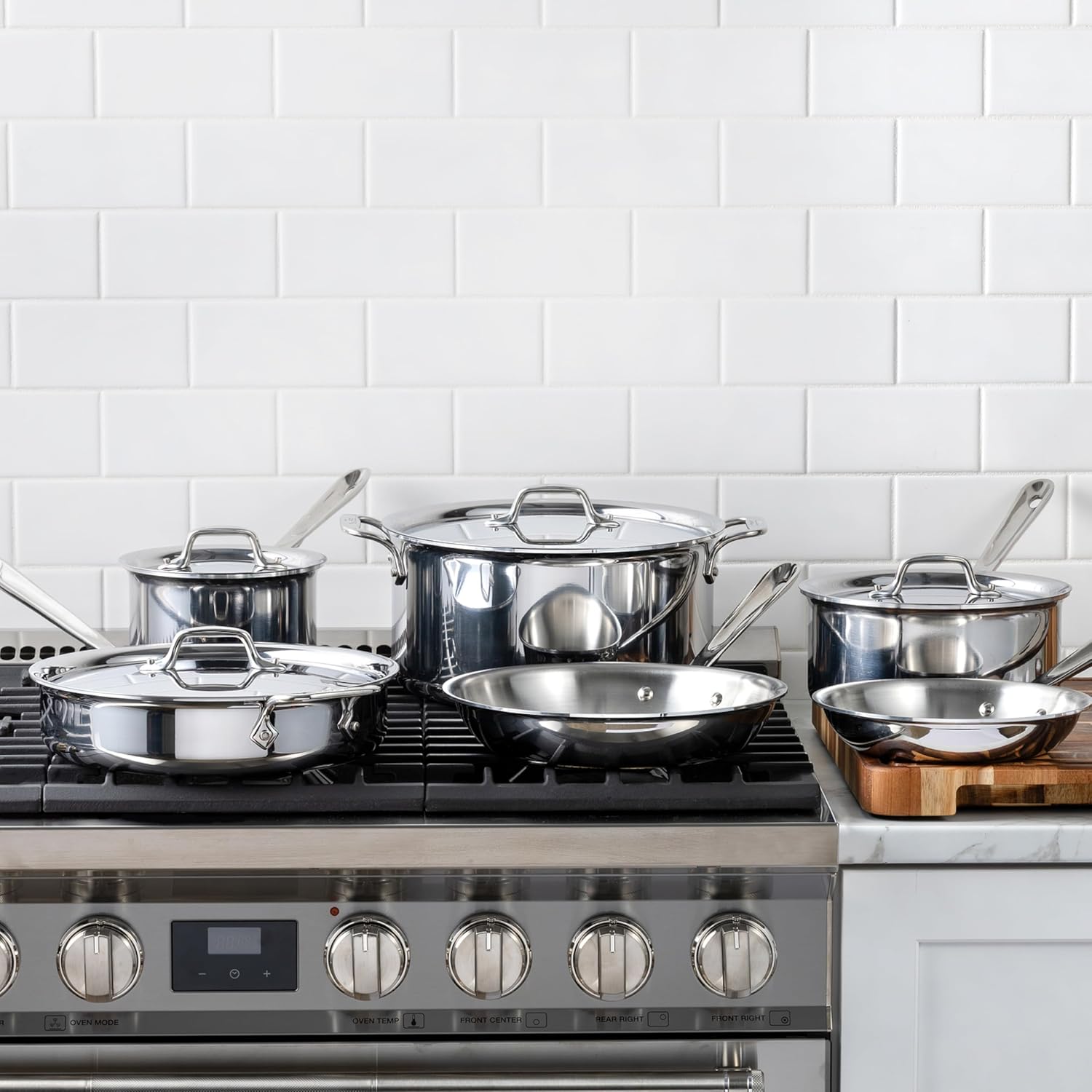
You’ve probably already ruled out nonstick for your everyday cooking, done a lap through cast iron, and landed here: stainless steel sets. Smart place to land. Stainless is the workhorse of serious home kitchens — it can sear, deglaze, go from stovetop to oven, and last decades without babying. But the category is genuinely confusing because “stainless steel” tells you almost nothing about how a pan actually performs. The meaningful differences live inside the pan: how many layers of metal are bonded together (the “ply count”), which metals are used, and whether that bonded construction — called clad construction — runs the full length of the pan’s sides or just sits under the base as a disk. Those decisions determine whether heat spreads evenly, whether the handle stays cool, whether the pan warps, and ultimately whether a $150 skillet performs closer to a $50 one or a $350 one. This guide breaks all of that down, then tells you exactly which sets make sense for which kitchens.
What Ply Count Actually Means (and Where It Gets Misused)
Ply count refers to the number of metal layers bonded together in a piece of clad cookware. The standard architecture you’ll see:
- 3-ply (tri-ply): Stainless interior → aluminum core → stainless exterior
- 5-ply: Stainless interior → aluminum → stainless → aluminum → stainless exterior (or variations swapping in a steel layer)
- 7-ply: Usually stainless + alternating aluminum and stainless layers, thicker overall
Here’s the thing most marketing won’t tell you: ply count is not a direct proxy for performance. What actually matters is total thickness and core material thickness. A well-engineered 3-ply pan with a thick aluminum core — say, 2.5mm to 3mm of aluminum — will outperform a thin 5-ply pan where each layer is negligibly thin. The aluminum is the heat conductor here; stainless steel conducts heat poorly on its own (roughly one-eighth the thermal conductivity of aluminum, per Fine Cooking’s overview of cookware materials). More stainless layers without a thicker conductive core just adds weight and marketing language.
America’s Test Kitchen’s equipment reviews consistently make this point in their skillet testing methodology: they measure actual temperature evenness across the cooking surface, not ply count, and 3-ply pans from brands like All-Clad and Tramontina regularly match or beat thinner 5-ply competitors from less-established manufacturers.
The actual question to ask: What is the total wall thickness, and how thick is the conductive core? Reputable brands publish this; many cheaper brands do not.
Full Clad vs. Impact-Bonded Disk Base: Here’s the Actual Difference
This is the bigger quality divide in the stainless category — more important than ply count for most buyers.
Full-clad (fully clad) means the bonded metal layers extend all the way up the sidewalls of the pan, not just across the bottom. Heat can travel up the sides, you get even cooking when a pan is loaded with liquid (braising, sauces), and the pan is structurally more rigid.
Disk-base (encapsulated base / impact-bonded) means a separate bonded disk — usually aluminum sandwiched between two stainless layers — is welded or pressed onto the bottom of an otherwise single-layer stainless pan. The bottom heats evenly, but the walls are thin stainless, which conducts poorly. For boiling pasta water? Fine. For searing a thick pork chop or reducing a wine sauce where liquid climbs the sides? You’ll notice the difference.
Wirecutter’s cookware set reviews draw this line clearly in their buying guides: they recommend full-clad construction as the baseline for anyone serious about stovetop cooking, while acknowledging that disk-base pans can be a reasonable tradeoff at lower price points for cooks whose use cases don’t push the limits.
By the Numbers
| Construction | Typical Wall Thickness | Heat Distribution | Price Range (10-12 pc set) |
|---|---|---|---|
| Disk-base stainless | 0.5–0.8mm walls | Base only | $80–$200 |
| Full-clad 3-ply | 2.0–2.6mm total | Base + sidewalls | $180–$500 |
| Full-clad 5-ply | 2.6–3.5mm total | Base + sidewalls | $350–$900+ |
Which Sets Are Actually Worth Buying at Each Price Point
The $150–$250 Range: Tramontina Tri-Ply Clad
Tramontina’s tri-ply clad sets represent one of the genuine price-to-performance wins in cookware. Reviewers at Wirecutter and Serious Eats both point to Tramontina as the answer when someone asks “is the All-Clad premium actually worth it?” The construction is legitimately full-clad 3-ply, the aluminum core is substantial (owners consistently report the same even-heating characteristics they’d expect from sets costing twice as much), and the sets typically include genuinely useful pieces rather than padding with rarely-used sizes.
The tradeoff: handles are slightly bulkier than All-Clad’s, the stainless finish is less refined, and the brand carries no particular prestige. For the cook who’s optimizing for actual cooking performance per dollar spent — not kitchen aesthetics — this is the correct answer.
If you’re here: Tramontina Tri-Ply Clad 12-piece set.
The $350–$550 Range: All-Clad D3 Stainless
All-Clad’s D3 line is the benchmark that other manufacturers get compared against, and it earns that position. The tri-ply construction runs the full length of the pan including the handle connection, the stainless is 18/10 (meaning 18% chromium, 10% nickel — more corrosion-resistant than 18/0 stainless used in cheaper sets), and the fit and finish is noticeably better than the budget tier. Owners report that pans bought 15 to 20 years ago still perform identically to new ones, which matters when you’re amortizing cost over real kitchen life.
America’s Test Kitchen’s long-run equipment assessments consistently rate All-Clad D3 at or near the top of the stainless skillet category. The ergonomic complaint — the handle is thin and can feel uncomfortable during long searing sessions — is real and worth knowing going in.
If you’re here: All-Clad D3 Stainless 10-piece set.
The $550–$900 Range: All-Clad D5 Brushed Stainless
The D5 adds two additional layers — a second aluminum layer and a stainless layer between them — bringing the total to 5-ply. The pitch is slower, more even heat response: less hot-spotting on high-BTU gas burners, more forgiving cooking behavior during long-simmer applications. Consumer Reports’ cookware ratings confirm that the D5 shows measurably more even heat distribution than the D3 across the cooking surface.
Here’s who should actually buy the D5 over the D3: cooks on powerful gas ranges (18,000 BTU+) who notice scorching at the base edges of D3 pans during high-heat sears; cooks doing a lot of delicate reduction work; and anyone for whom the brushed finish aesthetic is a meaningful decision. For induction users, the thicker construction actually helps here — the slower, more distributed heat matches induction’s precise delivery well.
Here’s who should skip the D5: induction users cooking at moderate heat levels, electric coil or smooth-top users, and anyone who already cooks well with D3 or equivalent. The performance delta is real but marginal for most home cooking scenarios.
If you’re here: All-Clad D5 Brushed 10-piece set.
The Splurge Tier ($900+): Hestan NanoBond and Made In
Two sets worth naming at the top of the market for different reasons.
Hestan NanoBond uses a proprietary titanium molecular bonding process on the exterior surface — not a coating, but a structural metallurgical process — that Hestan claims makes the surface harder and more scratch-resistant than standard stainless. The core construction is 5-ply. Reviewers at Fine Cooking and Epicurious describe the cooking surface as remarkably non-reactive and easy to clean. At over $1,200 for a full set, this is a prestige-tier purchase; the premium buys build quality and longevity rather than dramatically different cooking behavior versus a well-made D5.
Made In has grown quickly in this space and targets the direct-to-consumer prosumer: 5-ply construction, French steel sourcing, reasonable pricing at $700–$850 for a full set. Across aggregated reviews, owners consistently report performance comparable to All-Clad D5 at a meaningful discount, with a more modern handle design that many users prefer. The brand is newer and lacks the decades-long ownership track record of All-Clad, which is worth weighting if long-term durability data matters to you.
Induction Compatibility and What Actually Matters
All full-clad stainless sets with a magnetic stainless exterior are induction-compatible — and essentially all reputable stainless sets use a magnetic exterior layer. The nuance: disk-base pans can work on induction but may perform inconsistently because the thin sidewalls don’t distribute heat past the base footprint. On induction, that matters more than on gas because the heat source is precisely bounded by the coil diameter.
If your kitchen runs induction, the D5’s slower thermal mass actually harmonizes well with induction’s responsive, precise energy delivery. The D3 and Tramontina also work perfectly well on induction — just be aware that higher-output induction burners (3,600+ watts) may still show some base-edge concentration in thinner 3-ply pans.
The Decision Framework
Here’s how to cut through it:
-
You cook on a budget and want full-clad construction: Tramontina Tri-Ply Clad. Genuine full-clad at a price that makes the performance-per-dollar math undeniable.
-
You want the benchmark, long-term durability, and cooking performance that matches the serious home cook standard: All-Clad D3. This is the correct answer for the majority of this audience.
-
You cook on a high-BTU gas range and notice hot spots, or you’re doing precision reduction work: All-Clad D5 or Made In 5-ply. The extra ply count earns its keep in your specific use case.
-
You’re equipping a food-content kitchen, a supper-club setup, or you simply want the best-built pan available and the price is secondary: Hestan NanoBond or All-Clad Copper Core (5-ply with a copper center layer, at a similar price point, offering faster thermal response than aluminum-only 5-ply).
-
You’re on induction in an apartment and need pieces that perform without drama: Any of the full-clad options above. Skip disk-base entirely.
The honest summary: don’t let ply count be the deciding variable. Total construction thickness, full-clad versus disk-base, and core material quality matter more. A well-engineered 3-ply pan will outlast and outperform a poorly-engineered 5-ply pan every time. Buy the construction, not the number.