You’ve just moved into a place with a kitchen the size of a walk-in closet — or maybe you’ve been cooking in one for years — and the fantasy of a twenty-piece cookware collection stacked across twelve linear feet of open shelving is not your reality. Counter space in an apartment kitchen is a zero-sum game: every pot you own has to earn its square footage, or it ends up living on the floor. But “small kitchen” doesn’t mean compromising on how seriously you cook. It means buying smarter — choosing pieces that do double or triple duty, stack efficiently, and perform at the level a serious home cook actually demands. This guide is for the person who has done enough research to know the difference between a clad stainless pan (multiple layers of metal bonded together for even heating) and a carbon steel skillet (lightweight, naturally nonstick when seasoned, and loved by restaurant line cooks), but is still deciding which three or four pieces actually belong in their cabinet.
The short answer: prioritize function overlap, stackability, and induction compatibility — because induction cooktops (which use magnetic fields to heat pans directly, with no open flame) are now common in apartment buildings and rental kitchens, and they impose hard constraints on what you can use.
| EDITOR'S PICKOXO Outdoor Pre-Seasoned Carbon… | Mid-tier[Lodge Essential Enamel Braiser](https://www.amazon.com/dp/B07GVRG619?tag=greenflower20-20)… | Budget pick[Lodge Seasoned Cast Iron Skille](https://www.amazon.com/dp/B00G2XGC88?tag=greenflower20-20)… | |
|---|---|---|---|
| Type | Carbon steel fry pan | Enamel braiser | Cast iron skillet |
| Diameter | 12" | — | 10.25" |
| Capacity | — | 3.5 qt | — |
| Induction | ✓ | ✓ | — |
| Detachable Handle | ✓ | — | — |
| Price | $69.99 | $66.95 | $23.85 |
| See on Amazon → | See on Amazon → | See on Amazon → |
The Core Philosophy: Every Piece Earns Three Jobs
The worst thing you can do in a small kitchen is buy single-purpose cookware. A crepe pan is a beautiful object. It also takes up exactly as much cabinet real estate as a 10-inch skillet that could sear a steak, fry an egg, and bake a skillet cookie. If a piece can’t answer “what else do you do?” with at least two credible responses, it probably doesn’t belong in a space-constrained kitchen.
The framework that works for most intermediate cooks with limited space is what you might call a three-vessel kitchen: one workhorse skillet, one high-walled braiser or Dutch oven (a heavy, lidded pot designed for long, slow cooking with liquid — also excellent for soup, pasta water, and frying), and one saucepan. Everything else is additive and optional. Reviewers at Wirecutter’s cookware coverage consistently recommend anchoring a collection around a 10- or 12-inch skillet and a 5–6 quart Dutch oven as the core pair, noting that most everyday cooking falls within those two vessels.
The real skill is in choosing which skillet, which Dutch oven, and which saucepan — because the wrong material or wrong size in a small kitchen creates problems that the right pick avoids entirely.
The Skillet Decision: Carbon Steel vs. Cast Iron vs. Clad Stainless
This is where most apartment cooks get stuck, and for good reason — it’s a genuine tradeoff.
Cast iron (think Lodge or Le Creuset’s enameled versions) is phenomenally durable and retains heat beautifully for searing. Owners consistently report that a well-maintained cast iron skillet outlasts everything else in their kitchen by decades. The problem in a small kitchen: a 12-inch Lodge cast iron weighs roughly 8 pounds. That’s heavy to maneuver, awkward to store, and genuinely tiring to lift daily. Enameled cast iron like Le Creuset adds cost ($200+ for a skillet) but removes the seasoning maintenance requirement. If cast iron is your pick, go 10-inch and accept that you’re making a longevity-over-convenience trade.
Carbon steel is the restaurant line cook’s answer to this problem. It’s thinner and lighter than cast iron — roughly half the weight at the same diameter — but still builds a seasoned nonstick surface over time and handles high-heat searing without complaint. Serious Eats’ carbon steel skillet guide highlights the Matfer Bourgeat 11-7/8-inch as a benchmark, noting that owners report it heats faster and more evenly than heavier cast iron alternatives at a fraction of the weight. The tradeoff: carbon steel requires active seasoning maintenance and is reactive (meaning acidic foods like tomato sauce or wine can strip the seasoning and pick up a metallic taste). For a small kitchen, carbon steel is often the better daily-use skillet because it stores flat, stacks cleanly, and doesn’t require a separate storage strategy just to protect your lower-back.
Clad stainless — pans like the All-Clad D3 or D5, where alternating layers of stainless and aluminum are bonded together — is the most versatile surface because it’s nonreactive. You can deglaze with wine, cook tomato sauce, and go from stovetop to oven without concern. Cook’s Illustrated’s skillet ratings consistently place fully clad stainless at the top for performance, with owners reporting even browning and reliable fond development (the caramelized bits that stick to the pan and become the base for sauces). The case against clad stainless in a small kitchen: price scales quickly ($130–$200+ for a quality 12-inch), and nonstick performance requires technique rather than surface coating.
The practical verdict if you can only own one skillet: Carbon steel is the pick for the cook who sears proteins frequently and doesn’t mind the maintenance learning curve. Clad stainless is the pick for the cook who does more sauce work and wants to skip the seasoning ritual. Cast iron is the pick only if you have specific cast iron use cases — cornbread, deep-dish pizza — that can’t be handled by the other two.
The Dutch Oven: Where “Multifunctional” Actually Delivers
A good Dutch oven (5–7 quart capacity, enameled cast iron or bare cast iron) is arguably the highest-leverage piece in a small kitchen. Eater’s Dutch oven guide notes that owners routinely use them for braising, soups, stews, no-knead bread, deep frying, and even pasta — effectively replacing a stockpot, a braiser, and sometimes a roasting pan.
By the numbers:
- Le Creuset 5.5-qt Round Dutch Oven: ~$420 retail (2026 pricing)
- Staub 5.5-qt Cocotte: ~$380 retail
- Lodge 6-qt Enameled Dutch Oven: ~$80 retail
- Marquette Castings 5.5-qt: ~$160 retail
The Lodge is the honest budget answer. Across aggregated reviews, the pattern is clear: Lodge’s enamel is slightly thicker and more prone to chipping on the interior rim compared to Le Creuset and Staub, but the cooking performance difference is marginal for most home applications. If the $340 price gap between Lodge and Le Creuset represents a meaningful purchase decision for you, Lodge is 85–90% of the way there.
If you’re buying once and keeping it for fifteen years — and a Dutch oven is exactly that kind of purchase — Staub’s matte black interior is worth calling out separately. Apartment Therapy’s small kitchen cookware coverage notes that Staub’s interior surface develops a nonstick patina over time similar to carbon steel seasoning, and the self-basting lid (with textured bumps that return condensation to the food) is a genuine functional difference owners consistently praise. Le Creuset’s lighter interior makes browning easier to monitor. That’s the real tradeoff between those two — not quality, but use-case preference.
For induction users specifically: all enameled cast iron Dutch ovens (Le Creuset, Staub, Lodge) are induction compatible. Verify before buying bare cast iron from smaller producers; magnetic compatibility varies.
The Saucepan Nobody Talks About (But Should)
The saucepan is the most under-considered piece in most home cook setups — and in a small kitchen, picking the wrong one costs you significant storage space for minimal gain.
The honest recommendation: a 3-quart clad stainless saucepan with a lid handles 90% of saucepan tasks — reheating, making sauces, cooking grains, blanching vegetables — and stacks inside your Dutch oven when stored. This is the functional advantage that a separate small saucepan provides: nestability. A 3-quart sits cleanly inside a 5.5-quart Dutch oven, turning two pieces into one cabinet footprint.
Food & Wine’s cookware coverage consistently recommends All-Clad’s 3-quart saucepan as a benchmark, with owners noting the riveted handle and straight walls make it easy to whisk in without catching a balloon whisk on a curved interior. At roughly $130–$160 for the D3 version, it’s a considered purchase — but owners report using it daily for years without visible wear.
If budget is the constraint, the Cuisinart MultiClad Pro 3-quart is the most-cited affordable alternative in aggregated reviews, with owners reporting performance close to All-Clad at roughly $50–$60.
What to Skip (and Why)
Stockpots: Unless you’re making stock weekly, a Dutch oven handles soup and pasta water adequately. A 12-quart stockpot is enormous dead weight in a small kitchen for the three times a year you’d actually use it.
Nonstick skillets as a primary pan: A dedicated nonstick skillet is genuinely useful for eggs and delicate fish. But nonstick coatings degrade — Food & Wine’s nonstick pan testing notes that most PTFE-coated (the slippery polymer surface) pans show significant wear within 2–3 years of regular use, even with careful handling. In a small kitchen, that’s a piece that occupies permanent real estate and has a built-in expiration date. If you need nonstick, a single 10-inch nonstick skillet is a fine secondary purchase; it just shouldn’t be your primary.
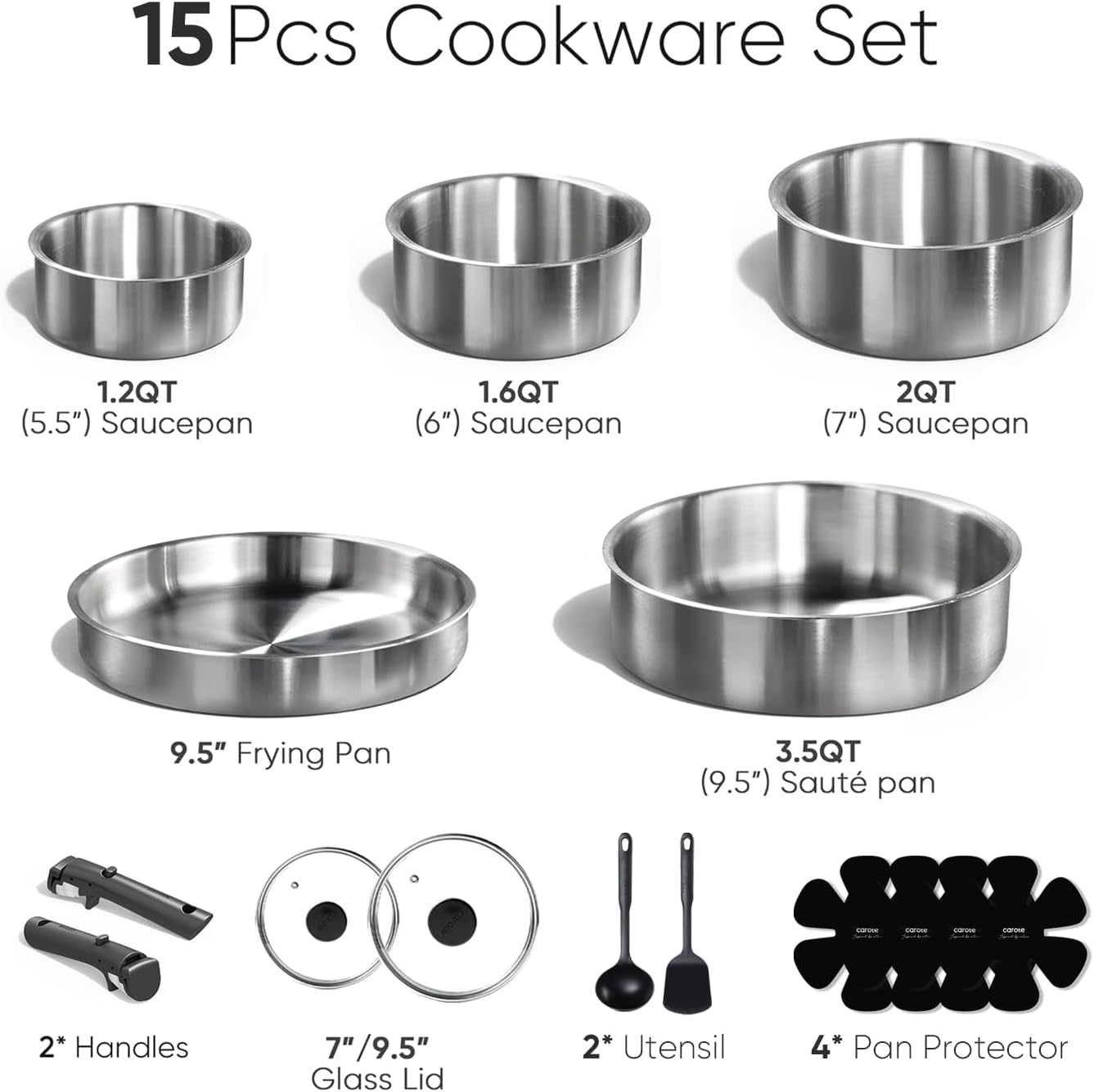
Matching sets: Cookware sets look appealing because they photograph well and seem economical per piece. In practice, most sets include pieces that don’t earn space in a small kitchen — a sauté pan, a second small saucepan, a pasta insert. Wirecutter’s cookware set guide notes explicitly that most home cooks are better served building a collection of individual pieces matched to their actual cooking patterns rather than buying a set and working around the pieces they don’t need.
The Decision Framework: If X, Then Y
Here’s how to use all of this when you’re standing at the purchase decision:
-
If you cook primarily proteins and high-heat dishes → Carbon steel skillet (Matfer Bourgeat or de Buyer Mineral B) + 5.5-qt enameled Dutch oven (Staub or Lodge) + 3-qt clad saucepan. This is your three-piece kitchen.
-
If you do more sauce and braising work than searing → 12-inch clad stainless skillet (All-Clad D3 or D5) + 5.5-qt Dutch oven + 3-qt saucepan. Same structure, different skillet surface.
-
If you’re on a strict budget → Lodge 10-inch carbon steel skillet (
$30) + Lodge 6-qt enameled Dutch oven ($80) + Cuisinart MultiClad Pro 3-qt saucepan (~$55). Total outlay under $170, and every piece earns its space. -
If you’re buying once for the next decade → De Buyer Mineral B 11-inch carbon steel + Staub 5.5-qt cocotte + All-Clad D3 3-qt saucepan. Total outlay ~$500–$550, and none of these pieces have an expiration date.
-
If you’re on induction → Confirm magnetic compatibility before purchasing any carbon steel or bare cast iron. All enameled cast iron and clad stainless are induction-safe by default.
The small kitchen doesn’t punish ambition. It punishes redundancy. Three pieces that each do three jobs will outperform twelve pieces where half of them are collecting cabinet dust — and you’ll cook better for knowing exactly what you have and why every piece is there.