You already own a good chef’s knife — maybe a Victorinox Fibrox, maybe a Wüsthof Classic, maybe you went full enthusiast and picked up a Shun. It handles most of what you throw at it. But you’ve probably noticed moments where it feels slightly awkward: tall vegetables that wobble under a curved blade, fish fillets that catch and tear, bread that compresses before it cuts. Those friction points aren’t skill gaps — they’re tool gaps. Specialty knives (blades designed for a specific task or cutting style) exist precisely because a single blade profile can’t be optimal for everything. This guide walks through the most useful specialty knives for a serious home kitchen — the nakiri, santoku, boning, bread, and a few others worth knowing — and tells you honestly which ones earn permanent counter space and which ones you can skip.
| EDITOR'S PICKMITSUMOTO SAKARI 4-Piece Japane… | Mid-tier[MITSUMOTO SAKARI 8-Inch Japanes](https://www.amazon.com/dp/B0CSYZ169P?tag=greenflower20-20)… | Budget pickPAUDIN Nakiri Knife - 7" Razor… | |
|---|---|---|---|
| Blade Material | San-Mai 9Cr18MoV | San-Mai 9Cr18MoV | High Carbon Stainless Steel |
| Knives Included | 4 | 1 | 1 |
| Handle Material | Rosewood | Rosewood | — |
| Blade Finish | Tsuchime | Tsuchime + Kurouchi | — |
| Heat Treatment | Deep-Cryo | Deep-Cryo | — |
| Storage Included | ✓ | — | — |
| Price | $137.19 | $45.20 | $24.87 |
| See on Amazon → | See on Amazon → | See on Amazon → |
The Nakiri vs. Santoku Decision: Here’s the Actual Difference
These two Japanese-style knives (both originating in Japan, both lighter and thinner than a typical Western chef’s knife) get conflated constantly. They’re not the same tool.
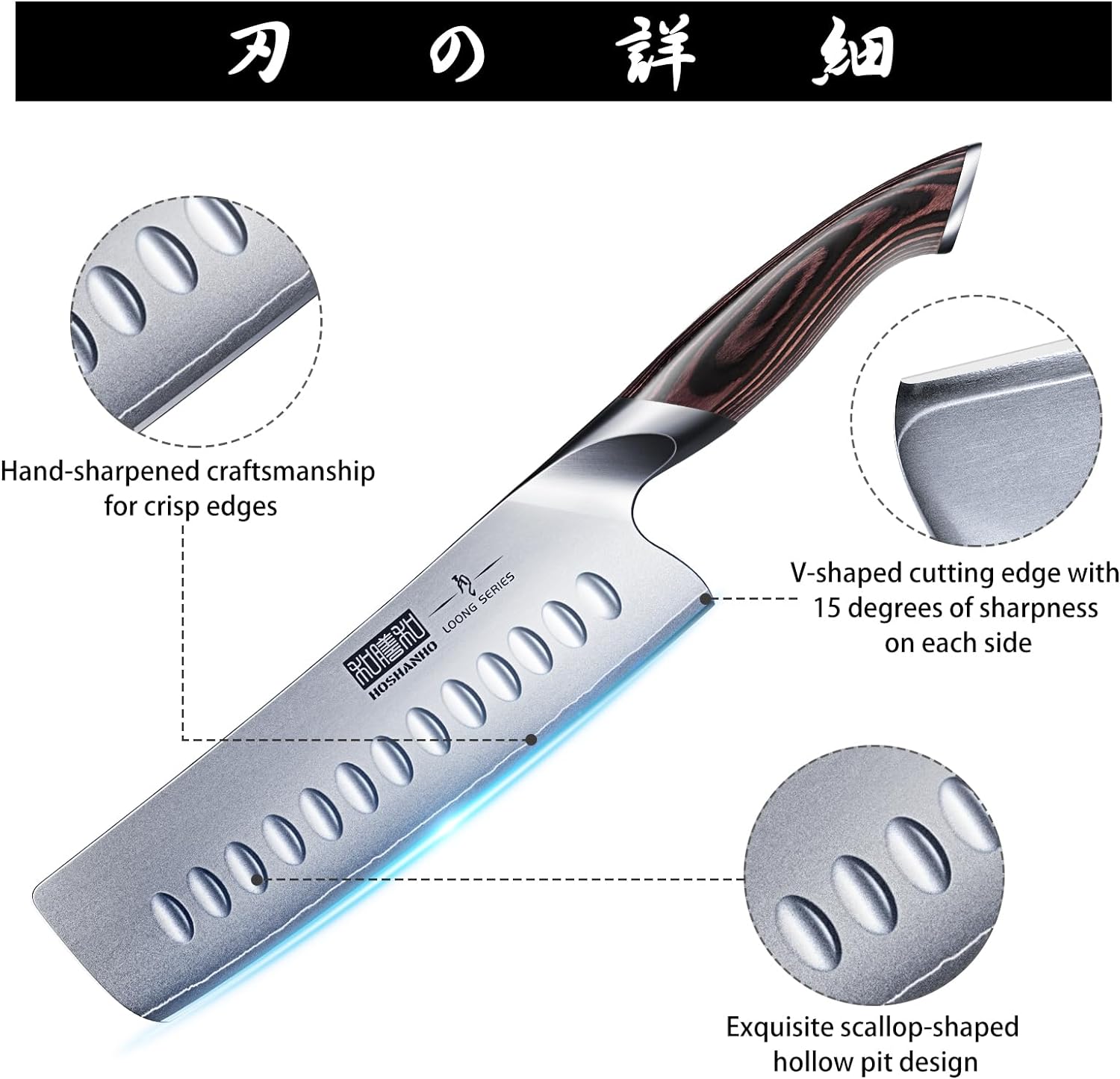
The nakiri (nah-KEE-ree) is a rectangular vegetable knife with a flat cutting edge — almost no curve at all. That flat profile means the entire blade contacts the board on a straight push-down chop, which is exactly what you want for dense vegetables: cabbage, carrots, daikon, fennel. You don’t rock it like a Western knife; you use a forward-and-down motion that’s actually faster for high-volume vegetable prep. The blade is typically 165–180mm (roughly 6.5–7 inches), double-beveled (sharpened on both sides, unlike some traditional single-bevel Japanese knives), and thin enough that it doesn’t wedge or split hard produce the way a thicker chef’s knife can.
The santoku (san-TOE-koo — literally “three virtues,” referring to meat, fish, and vegetables) has a subtly curved edge and a sheepsfoot tip (the spine curves down to meet the edge rather than the edge curving up to meet the spine). It’s more versatile than the nakiri — you can manage proteins with it — but it doesn’t do any single job as cleanly. The blade is typically 165–180mm as well, and most santokus have a slightly thicker spine than a nakiri, making them a touch more durable.
Here’s the decision rule:
- If you cook predominantly plant-forward meals, do a lot of Japanese or Korean prep, or find yourself fatigued by the rocking motion of a Western chef’s knife — get the nakiri.
- If you want a lighter, slightly shorter general-purpose knife that works across proteins and produce — get the santoku.
- If your chef’s knife is already a Japanese gyuto (a thin, double-beveled knife in the 210–240mm range) — the santoku is largely redundant. Add the nakiri instead.
Serious Eats’ Japanese knife guide notes that the nakiri’s flat profile gives it a measurable advantage on push-cuts through vegetables specifically, while the santoku functions as a more universally capable blade. Food & Wine’s santoku roundup makes the same distinction: santoku owners tend to reach for it as a daily driver when they want something lighter than their 8-inch Western knife, not as a specialist tool.
By the Numbers
| Knife | Typical Length | Edge Profile | Best Use |
|---|---|---|---|
| Nakiri | 165–180mm | Flat (no curve) | Vegetables, push-cuts |
| Santoku | 165–180mm | Slight curve, sheepsfoot tip | General purpose, lighter daily driver |
| Western Chef’s Knife | 200–240mm | Curved, pointed tip | Rocking cuts, proteins, versatility |
| Gyuto | 210–240mm | Thin, curved, pointed | Japanese-style all-purpose |
The Boning Knife: Underrated, Genuinely Useful
A boning knife has a thin, stiff or semi-flexible blade (typically 5–6 inches) designed to navigate around bones, cartilage, and joints. It’s not glamorous, but if you ever break down whole chickens, French a rack of lamb, or butcher pork shoulder, it transforms the job from frustrating to methodical.
The key spec to understand is blade flexibility. Stiff boning knives are better for beef and pork, where you’re working against denser bones and need leverage. Flexible boning knives are better for fish and poultry, where you want the blade to follow the contour of bones without tearing flesh.
Cook’s Illustrated has consistently rated the Victorinox 6-Inch Fibrox Boning Knife as the best value in this category — owners report that its semi-stiff blade handles both poultry and light pork work without committing fully to either extreme. For buyers willing to spend more, the Wüsthof Classic 5-Inch Boning Knife and the Shun Classic Boning Knife both get strong long-run reviews from owners who prioritize edge retention over entry-level price.
Who should skip it: If you buy proteins pre-portioned and never work whole animals, this knife will sit unused. Be honest with yourself. If you spatchcock a chicken twice a year, your chef’s knife will get you there — it’s just less elegant.
Bread Knife: The One You Can’t Fake With a Substitute
Here’s where the “one knife to rule them all” argument fully collapses. A serrated bread knife — typically 9–10 inches, with offset scalloped serrations along the blade — is genuinely irreplaceable for anything with a hard crust and a soft interior. Sourdough. Brioche. Tomatoes. Cakes with delicate crumb. A straight-edged knife compresses before it cuts; the serrations bite and saw through with zero downward pressure.
The Wirecutter’s chef’s knife guide (and its companion bread knife coverage) points to the Victorinox 10.25-Inch Fibrox as the crowd-consensus budget pick — virtually every owner review notes it outperforms knives three times the price on practical bread-cutting. At the premium end, the Wüsthof Classic 9-Inch Double Serrated Bread Knife adds offset serrations that reduce knuckle drag on wide loaves, and owners consistently report it maintains its edge through years of regular use without needing professional resharpening.
One practical note: serrated knives require a specialty sharpening rod (a tapered ceramic rod) rather than a standard whetstone, and many home cooks simply send them out for sharpening every few years. Factor that into the ownership picture.
Specialty Blades Worth Knowing (Even If You Don’t Own Them Yet)
The Petty or Paring Knife
A petty knife is a Japanese-style utility blade, typically 120–150mm — think of it as a longer, thinner paring knife. It’s used for in-hand cutting, small precise work, and anything where you want a chef’s knife but don’t have the board space. Epicurious’ guide to Japanese knives calls the petty “the most versatile knife you’re not thinking about,” and that’s accurate: it bridges the gap between a paring knife (too short for some tasks) and a santoku (too long for others).
If you already have a Western paring knife, evaluate whether you’re actually happy with it before buying a petty. If your paring knife feels stiff and imprecise — many budget ones do — a petty in the 135–150mm range is a meaningful upgrade.
The Honesuki (Poultry Boning Knife)
The honesuki is a Japanese poultry-specific boning knife with a stiff, triangular blade and a single-bevel edge (sharpened on one side only, for clean separation). It’s more specialized than a Western boning knife — purpose-built for breaking down chicken and duck with precision. If you butcher poultry regularly and have already maxed out what a Western boning knife can do, the honesuki is the step-up. Most home cooks don’t need one; professional-adjacent cooks who source whole birds frequently will find it revelatory.
The Sujihiki (Slicing Knife)
A sujihiki (sue-JEE-hee-kee) is a long, thin Japanese slicing knife — typically 240–300mm — with a narrow profile that minimizes drag when cutting through proteins in single long strokes. It’s the tool for slicing roasted beef, carving a whole fish, or breaking down a large piece of salmon into sashimi. The Western equivalent is a carving or slicing knife, but the sujihiki is thinner and more precise.
Who needs it: Anyone doing tableside carving, supper-club hosting, or serious fish preparation. For most home cooks, a long chef’s knife or a standard carving knife is sufficient — but if you’re plating composed dishes or cutting sashimi regularly, the sujihiki is worth the investment.
The Real Question: Is Your Knife Block Getting Crowded for the Wrong Reasons?
The honest answer is that most intermediate home cooks are underusing a 2–3 knife kit and convincing themselves they need six. Before adding a specialty blade, run through this:
-
Are you actually hitting the limits of your current knife, or just bored with it? A nakiri is useful; it’s also an easy want-to-buy when your real problem is that your chef’s knife needs sharpening.
-
Does your cooking style align with the knife’s specialty? A bread knife earns its space in almost every kitchen. A honesuki earns its space in maybe 15% of them.
-
What does maintenance cost over five years? Japanese knives with harder steel (typically 60+ Rockwell hardness) take a sharper edge but chip more easily and require more careful sharpening technique — either learning to use a whetstone properly or paying for professional sharpening. Wirecutter and Serious Eats both flag this tradeoff consistently: harder Japanese steel rewards the cook who sharpens regularly; it punishes the one who doesn’t.
The Verdict: If X, Then Y
If you cook mostly vegetables and find your chef’s knife awkward on push-cuts: Get the nakiri. Start around $60–80 (the Mac Japanese Nakiri and Tojiro DP both get strong owner reviews at that range) and go up to $150–200 if you want something you’ll keep for a decade.
If you want a lighter daily driver that handles both produce and proteins: Get the santoku. The Shun Classic Santoku and Global G-48 are the enthusiast-tier picks that reviewers return to consistently.
If you bake or buy crusty bread: Get a good bread knife before anything else. The Victorinox handles it at $45; the Wüsthof double-serrated is the upgrade.
If you break down whole animals regularly: Add a boning knife — the Victorinox Fibrox boning knife at the entry level, a Wüsthof or Shun if you want to invest.
If you’re hosting, plating composed dishes, or cutting fish to order: The sujihiki is the one specialty blade that genuinely elevates those specific moments in ways nothing else replicates.
Every other knife is a nice-to-have. Buy the ones that match your actual cooking life, not the ones that look compelling in a display block. The drawer space, the sharpening discipline, and the money — they’re all finite. Spend them where you’ll notice.