You’ve been cooking on gas your whole life, and now your new apartment has an induction cooktop — a flat glass surface that heats pots using magnetic energy rather than an open flame or a glowing coil. Or maybe you’re staying put but considering an induction range because of the utility savings, and you don’t want to replace your whole kitchen before you commit. Either way, you’re staring at a cabinet full of cookware and wondering: what actually works, what definitely doesn’t, and is there a version of this that survives yet another move? This guide answers all of that. By the end, you’ll have a clear framework for auditing what you own, a shortlist of pans worth buying new, and a decision rule for every major cookware category — so you’re not locked into a single cooktop type ever again.
How Induction Actually Works (and Why It Makes Cookware Picky)
Induction cooktops generate heat by creating a rapidly alternating magnetic field beneath the glass surface. That field induces an electrical current — technically called an eddy current — directly inside the base of the pan, which heats from within rather than from an external flame. The upside: precise, fast, energy-efficient heating with a cool cooktop surface. The constraint: only cookware with a ferromagnetic base — meaning the metal can be attracted to a magnet — will work at all. Non-magnetic metals simply don’t interact with the field, and nothing heats.
The practical test is embarrassingly simple. Hold a refrigerator magnet to the bottom of any pan. If it sticks firmly, the pan will work on induction. If it slides off or doesn’t grab, it won’t. This one check eliminates most pure aluminum, most copper, and all glass or ceramic cookware immediately.
Metals that work: Cast iron, carbon steel, stainless steel with a magnetic (ferritic or martensitic) base layer, and some enameled cast iron.
Metals that don’t work on their own: Pure aluminum, pure copper, anodized aluminum (without a bonded steel base), and non-ferrous stainless alloys like 300-series stainless used alone.
The nuance most buyers miss: many mid-range and premium stainless pans — including multi-clad designs — use a fully clad or disc-bonded steel base that adds magnetic response. The aluminum core that makes them conduct heat beautifully is sandwiched between steel layers that make them induction-ready. So “stainless steel” doesn’t automatically mean induction-compatible; it depends on construction.
The Four Cookware Types, Ranked by Induction Friendliness
1. Cast Iron and Enameled Cast Iron — Native Induction Performers
Standard bare cast iron (Lodge, Finex, Field Company) and enameled cast iron (Le Creuset, Staub) are magnetically compatible by nature. They were induction-ready before induction existed. Owners across years of aggregated reviews consistently report that cast iron heats unevenly at first on induction because the magnetic field concentrates in the center of the burner zone, but that with a proper 4-6 minute preheat the mass of the pan distributes heat well enough for most tasks.
The honest caveat: cast iron is slow to respond to temperature changes regardless of heat source, and flat cast-iron bases become more important on induction (and glass-top electric) than on gas, where a slightly warped or rough base doesn’t matter. Reviewers at Wirecutter’s cookware coverage note that factory-machined bases on pans like those from Smithey or Butter Pat make noticeably better contact with flat induction surfaces than rough-cast Lodge bottoms — worth knowing if you’re buying new rather than using what you have.
If X, then Y: If you already own good cast iron, use it on induction without anxiety. If you’re buying new cast iron primarily for induction, a machined-bottom pan is worth the premium.
2. Carbon Steel — The Induction All-Star Most Cooks Underrate
Carbon steel — think of it as cast iron’s lighter, more responsive sibling — is ferromagnetic, heats faster than cast iron, and seasons in exactly the same way. Food & Wine’s roundup of best carbon steel pans notes that professional kitchens have used carbon steel on induction for years, precisely because the combination delivers the high-heat sear performance of cast iron with the responsiveness that gas-trained cooks expect.
Brands like Matfer Bourgeat, de Buyer Mineral B, and Lodge carbon steel all confirm induction compatibility in their published specs. The de Buyer Mineral B line in particular has a beeswax factory finish that owners report seasons more smoothly on induction than on gas because the controlled, even magnetic heat avoids hot-spot scorching during the first seasoning passes.
The trade-off: carbon steel is reactive (no acidic braises), requires seasoning maintenance, and can develop uneven seasoning if you let it sit wet. This is not a set-and-forget pan. But for the cook who wants one versatile induction-ready workhorse that also goes in a 500°F oven and doubles as a crêpe pan, it’s the highest performance-per-dollar option in this category.
3. Multi-Clad Stainless — The Safest Universal Bet
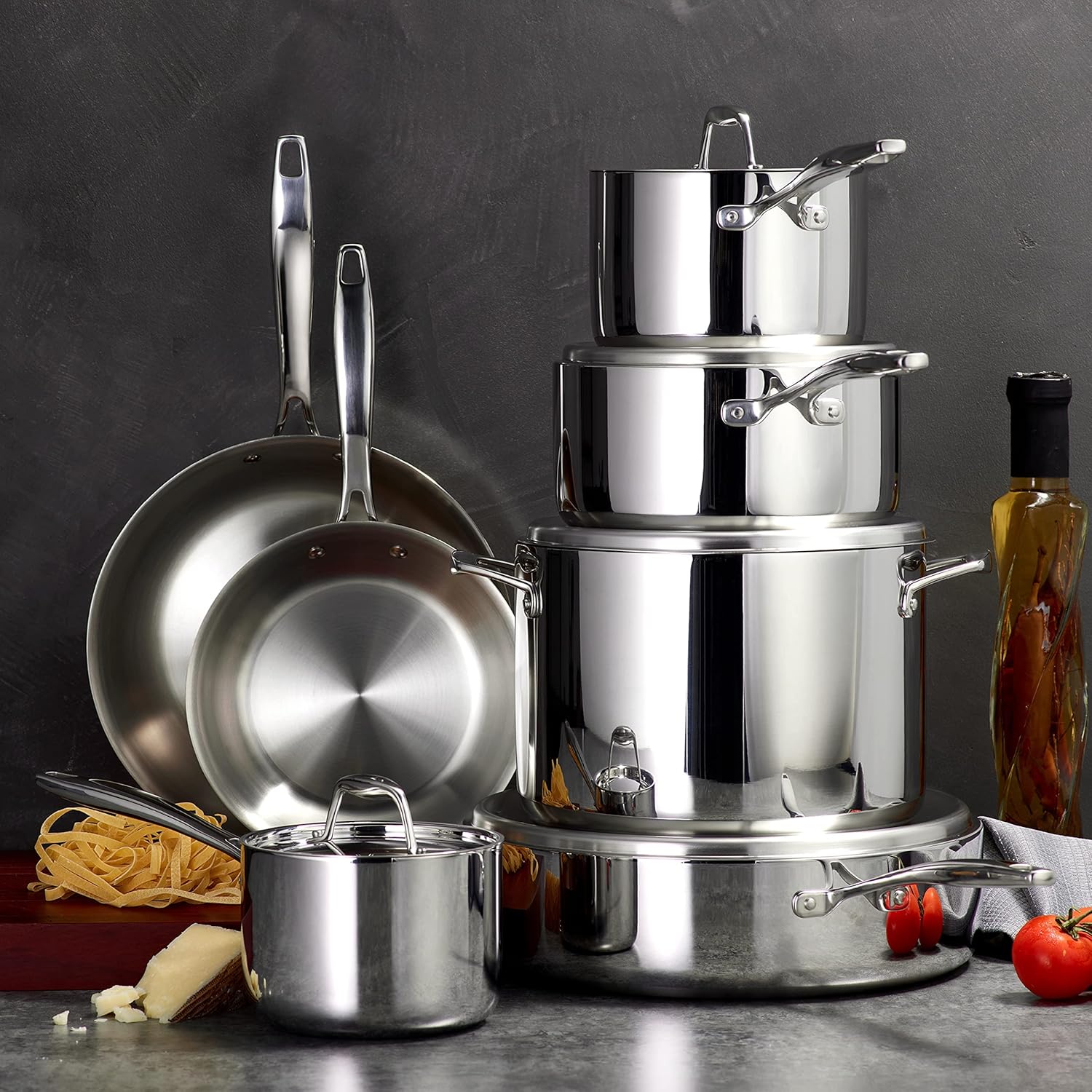
This is where most serious home cooks land for their core batterie, and for good reason. Multi-clad stainless — layers of aluminum (for conductivity) bonded between stainless steel layers — offers induction compatibility, dishwasher tolerance, non-reactive cooking surfaces, and no seasoning requirements. Serious Eats’ induction cookware coverage consistently ranks fully-clad lines like All-Clad D3, All-Clad D5, and Made In as reliable performers on induction because the exterior steel layer is magnetic.
The key thing to verify before you buy: “Stainless” and “clad” don’t automatically mean induction-ready. Budget stainless sets sometimes use 300-series austenitic stainless throughout — non-magnetic. A disc-bonded pan (a steel disc welded to the bottom of a thinner pan) works on induction and costs less than fully clad, but the heat distribution is less even because the magnetic base layer doesn’t extend up the sidewalls. Cook’s Illustrated’s skillet testing confirms that for tasks like reduction sauces and fond development, fully clad pans produce more even results because the heat climbs the walls.
By the numbers:
- All-Clad D3 10-inch skillet: ~$130 (fully clad, induction-confirmed)
- Made In 10-inch Stainless: ~$109 (fully clad, induction-confirmed)
- Tramontina Tri-Ply 10-inch: ~$40 (disc-bonded base, induction-confirmed, uneven wall heat)
- Misen 10-inch Stainless: ~$95 (fully clad, induction-confirmed)
The price gap is real. The performance gap on induction is mostly noticeable when you’re doing tasks where wall heat matters — reducing stocks, building pan sauces, stir-frying. For searing a steak or sautéing vegetables, the budget disc-bonded option performs closer to 85-90% as well.
4. Nonstick — Induction Works, But Read the Spec Sheet
The nonstick category is the most confusing for induction shoppers because the coating itself (PTFE, ceramic, etc.) is irrelevant to induction compatibility — what matters is the base material underneath. Many nonstick pans are built on pure aluminum, which is not induction-compatible. Others have a steel base layer added specifically for induction use, and the manufacturer will call this out clearly.
Owners report that T-fal’s Expertise and Prometal Pro lines, GreenPan’s Valencia Pro series, and Zwilling’s Madura Plus all carry induction-compatible bases confirmed in their published specs. Scanpan CTX — a heavier, Danish-made pan — is explicitly engineered for induction with a steel base and is one of the few nonstick pans Consumer Reports has rated for multi-hob compatibility without caveats.
The honest limitation of nonstick on induction: because induction heats so efficiently, it’s easy to overheat a nonstick surface if you default to your gas habits and crank the burner. PTFE coatings begin degrading above approximately 500°F, and induction can get there fast on high settings. The fix is discipline — medium heat is almost always sufficient for nonstick tasks. Ceramic coatings are more heat-tolerant but tend to lose their release properties faster than PTFE, typically within 1-3 years of regular use based on aggregated owner reviews.
The Audit Framework: What to Do With What You Already Own
Before spending a dollar, run this 10-minute exercise on your existing collection.
Step 1 — The magnet test. Every pan, every pot. Stick a fridge magnet to the bottom. Firm grab = keep. Weak grab or none = set aside.
Step 2 — Flatness check. Induction surfaces require good contact. Place each pan on a flat countertop and look for rocking or wobble. Warped pans will heat unevenly on induction even if they’re magnetic. This matters more on induction than on gas.
Step 3 — Identify your gaps. Most cooks find they’re missing two things after this audit: a proper nonstick (because many are pure aluminum) and a sauté or saucier (because mid-range clad is often where the budget got cut). Those are your two purchase priorities.
Step 4 — Don’t panic-replace everything. A warped skillet that wobbles slightly on induction may still be perfectly functional on your other hobs. Unless you’re going induction-only, keep usable pans in rotation even if they’re not magnetic.
The “Can’t Choose My Cooktop” Purchase Strategy
Here’s the honest position many cooks are in as of 2026: induction adoption in new residential construction has climbed steadily (per Consumer Reports’ appliance tracking), but most rental kitchens still have gas or coil electric, and many buyers are one move away from a different setup. Buying for maximum portability means prioritizing induction-compatible pans that also perform beautifully on gas and electric — which, fortunately, describes most of the best-reviewed cookware in every category.
The universal compatibility list that emerges from aggregated coverage across Serious Eats, Wirecutter, and Cook’s Illustrated consistently includes:
- Carbon steel skillet (de Buyer Mineral B Pro or Matfer Bourgeat) — works on every heat source including open flame and induction without modification
- Fully clad stainless sauté pan (All-Clad D3, Made In, or Misen) — induction, gas, electric, oven to 500°F, broiler
- Enameled cast iron Dutch oven (Le Creuset or Staub) — induction, gas, electric, oven, even campfire
- Induction-confirmed nonstick (Scanpan CTX or GreenPan Valencia Pro for the serious buyer; T-fal Expertise for the budget pick)
This four-piece foundation covers 95% of home cooking tasks on any cooktop you encounter. Everything else — copper accent pans, pure aluminum sauté pans, specialty clay pots — can be added as the luxury of a permanent kitchen setup allows.
The Verdict
If you know your next place will have induction and you’re buying from scratch: start with fully clad stainless and add one carbon steel skillet. Those two pans will be induction-native, gas-ready, and versatile enough that you won’t feel constrained. If you’re auditing an existing collection before a move: run the magnet test first, replace your nonstick second (it’s the category most likely to fail the test), and hold off on anything else until you know your actual cooktop situation.
The one thing worth avoiding is buying “induction-compatible” disc-bonded sets because they’re cheap, then wishing you’d spent a bit more on clad. The performance gap on induction is more pronounced than on gas — uneven bases and thin sidewalls show their weaknesses when the heat source is as precise and powerful as induction. Buy fewer, better pans, and they’ll follow you anywhere.