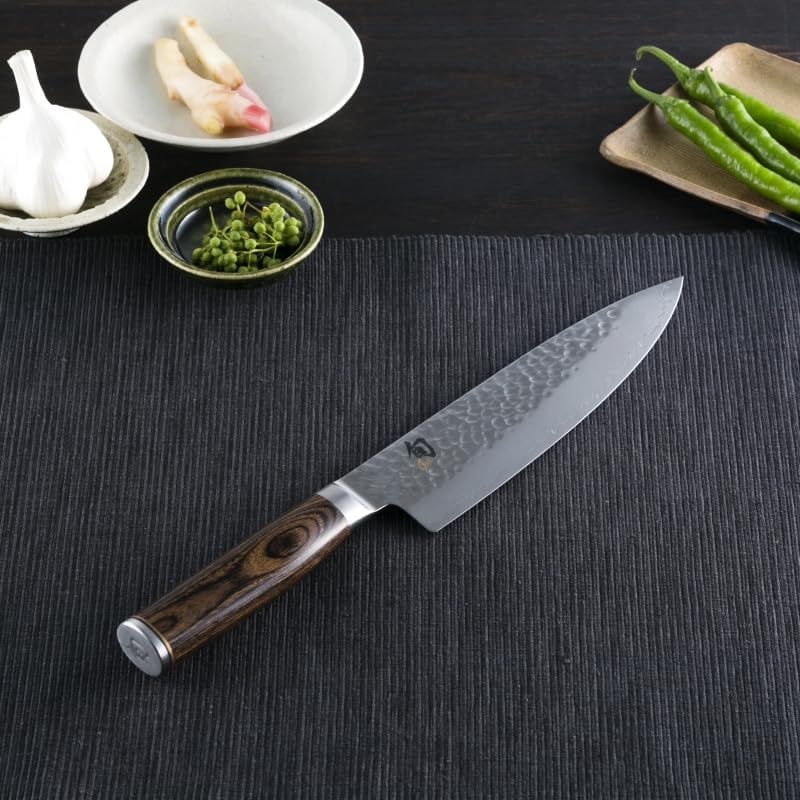
You’ve seen the photos: a chef’s knife with a rippling, almost water-like pattern along the blade, sitting next to a wooden cutting board with a sprig of rosemary for effect. Damascus knives — named after a centuries-old blade-making tradition involving layered steel — have become the prestige object of the serious home kitchen. At the same time, you’ve probably seen VG-10 mentioned in every Japanese knife thread you’ve ever read. VG-10 is a specific stainless steel alloy (a precise mixture of metals, including chromium, cobalt, and vanadium) that many Japanese knife makers use for their cutting core because it holds a very sharp edge without being brittle. The complication is that these two things — Damascus patterning and VG-10 steel — are frequently sold together as a package, which makes it genuinely hard to figure out what you’re actually paying for. This guide breaks down the actual metallurgy, names the real tradeoffs, and gives you a clear decision rule for where to put your money.
What Damascus Actually Is (and What It Isn’t)
Here’s the actual difference between historical Damascus and what’s on the market today: they share a name and an aesthetic, but almost nothing else.
True wootz Damascus — the steel that gave the original Damascus blades their legendary reputation in the medieval Islamic world — was a crucible steel with a distinctive carbide microstructure that produced both extreme hardness and flexibility. That process is essentially extinct. Modern “Damascus” knives are pattern-welded steel: a bladesmithing technique where two or more types of steel are stacked, forge-welded together under heat and pressure, then folded and drawn out repeatedly to create hundreds of alternating layers. When the finished blade is etched with acid, the different steels react at different rates, revealing the flowing, wood-grain pattern you see in product photography.
That process is genuinely skilled work. It is also — and this is important — entirely decorative from a performance standpoint in most production knives. The ripple pattern does not make the edge sharper. It does not improve edge retention. Per Serious Eats’ testing-informed coverage of chef’s knives, what matters for edge performance is the steel at the cutting edge itself, and that edge is almost always a single-alloy core regardless of what’s layered around it. The Damascus cladding wraps the sides of the blade; the actual cutting work is done by the core steel underneath.
The pattern is the point — as long as you know that going in. There is nothing dishonest about buying a Damascus knife because you love how it looks on your counter. But paying a $150 premium over a mono-steel equivalent purely on the assumption that the pattern means better cutting performance is where buyers go wrong.
VG-10: What the Spec Sheet Actually Tells You
VG-10 is a Japanese stainless steel developed by Takefu Special Steel. The “VG” stands for “Gold” (a branding choice, not a compositional one), and the “10” refers to its formulation. Its composition — roughly 1% carbon, 15% chromium, 1% cobalt, 0.2% vanadium — is optimized to hit a sweet spot that German stainless steels like X50CrMoV15 (found in Wüsthof and Henckels) don’t prioritize in the same way: very high hardness (typically 60–62 HRC on the Rockwell scale, which is the standard measurement of steel hardness) combined with meaningful corrosion resistance.
By the numbers:
- VG-10 typical hardness: 60–62 HRC
- German stainless typical hardness: 56–58 HRC
- Higher HRC = holds a thinner edge longer, but is more brittle and harder to resharpen at home
- Most production Damascus knife cores: VG-10 or SG-2 (a powdered steel with similar hardness)
What does that hardness premium actually mean in the kitchen? Wirecutter’s ongoing chef’s knife coverage notes that harder steels allow the blade to be ground to a more acute edge angle — typically 15° per side for Japanese knives versus 20–22° for German knives — which produces a noticeably more precise cutting feel on delicate tasks like slicing fish or brunoise-cutting shallots. The tradeoff is real: harder steel chips more readily if you use the knife carelessly (hitting a bone, twisting during a cut, or storing it loose in a drawer), and it takes more skill or the right tool to resharpen at home. A 60 HRC steel doesn’t respond well to a pull-through sharpener; you need whetstones or a quality guided system.
VG-10 also holds up well against rust if you hand-wash and dry it promptly, which matters because many Japanese-style knives have thinner, more reactive steel that requires more careful maintenance. For most home cooks who aren’t storing knives wet, VG-10’s corrosion resistance is genuinely adequate day-to-day.
The Production Reality: Where the Money Actually Goes
Here’s where the decision frame gets practical. Damascus VG-10 knives span a massive price range, and the distribution of that price tells you a lot.
A $60–$100 entry-level “Damascus” knife from a budget brand is almost certainly working with a budget VG-10 core of inconsistent heat treatment, with the Damascus cladding adding cost but not quality. The pattern is achieved with a lower layer count (sometimes 33 layers), the grind is less refined, and the handle fit-and-finish is often where corners get cut. Epicurious’s guide to Japanese kitchen knives specifically flags that layer count in marketing copy is largely meaningless — a 67-layer Damascus blade is not inherently superior to a 33-layer one; what matters is the quality of the forge weld and the consistency of the heat treat.
In the $150–$300 range, you’re getting into brands like Shun Classic (which uses a 68-layer Damascus cladding over a VG-10 core), Miyabi Birchwood, and Yoshihiro. This is the zone where reviewers consistently note that the execution tightens: the geometry is more deliberate, the edge comes from the factory at a consistent angle, and the handle materials are meaningfully better. Cook’s Illustrated’s comparative knife coverage points to this tier as where Japanese knife characteristics start to become reliably reproducible across units — not just a lucky sample.
Above $300, you’re generally moving away from VG-10 into steels like SG-2 (also called R2), HAP40, or White Steel #1 and #2. These are higher-performing but demand even more careful maintenance. At this level, Damascus cladding may be soft iron or stainless (protecting a reactive carbon-steel core from rust while the hard core does the cutting), which is a functionally meaningful use of the lamination technique, not just an aesthetic one. The Wirecutter notes that at this tier, buyers are often paying for a highly refined single craftsperson’s grind rather than a production spec.
Who Should Skip the Damascus Premium
If your current situation is any of the following, Damascus VG-10 probably isn’t the right spend:
You’re still learning sharpening. A 60+ HRC knife that gets a mediocre touch-up on a pull-through is worse than a 58 HRC knife properly maintained. Serious Eats’ knife coverage is consistent on this point: a sharp $80 German knife outperforms a dull $300 Japanese one every time. Until you’re comfortable on a 1000/6000 whetstone, the hardness premium doesn’t pay.
You cook in a high-volume, high-casualty environment. Supper club and pop-up contexts where knives are washed by others, stored communally, or used on hard surfaces favor toughness over hardness. German steel or a workhorse mono-steel Japanese knife (Victorinox Fibrox, Mac Professional) is a more practical match.
You want one knife to do everything including breaking down chickens. Hard VG-10 chips on bone. A 240mm VG-10 gyuto is magnificent for prep work; it is not a butcher’s knife.
The pattern is specifically why you want it. That’s fine — own that preference clearly. Buy the most beautiful Damascus knife in your budget, treat it well, and don’t feel defensive about the aesthetic motivation. Fine Cooking’s coverage of knife steel has long argued that the joy of cooking with a beautiful tool has real psychological value that the specs don’t capture. But don’t also tell yourself you’re buying it for performance reasons.
If X, Then Y: The Decision Rule
Here’s the framework for where you actually are right now:
If you’re buying your first serious Japanese knife and have $150–$200: Look at a mono-steel VG-10 or SG-2 option (Mac Professional, Tojiro DP) before paying for Damascus cladding. You get the steel performance without the pattern tax. Use the savings on a good whetstone.
If you’re buying a second or third knife and want something you’ll reach for on good days: The Shun Classic 8-inch or Miyabi Birchwood 9.5-inch tier is genuinely justified. You understand the maintenance, you have the sharpening setup, and you’ll actually appreciate what you’re getting. Owners across aggregated reviews consistently describe the Shun Classic as a knife that stays exciting to use, not just to look at.
If you’re shopping in the $300+ zone: Stop looking at Damascus as the differentiator and start comparing steel types, maker reputation, and grind geometry. At this level the pattern is almost an afterthought — you’re buying SG-2 or HAP40 or a named craftsperson’s work. The Damascus, if present, may serve a functional purpose (soft iron cladding over reactive steel), but it’s not the reason to buy.
If someone is selling you a Damascus knife and can’t tell you what the core steel is: Walk away. The core is the whole performance story. A vague “high-carbon stainless” answer on a $200+ knife is a red flag.
The ripple pattern is one of the more genuinely beautiful things in kitchen aesthetics. It’s worth something. It’s just not worth the same thing as the steel underneath it — and knowing the difference is exactly what makes you a buyer who gets both the performance and the pleasure right.