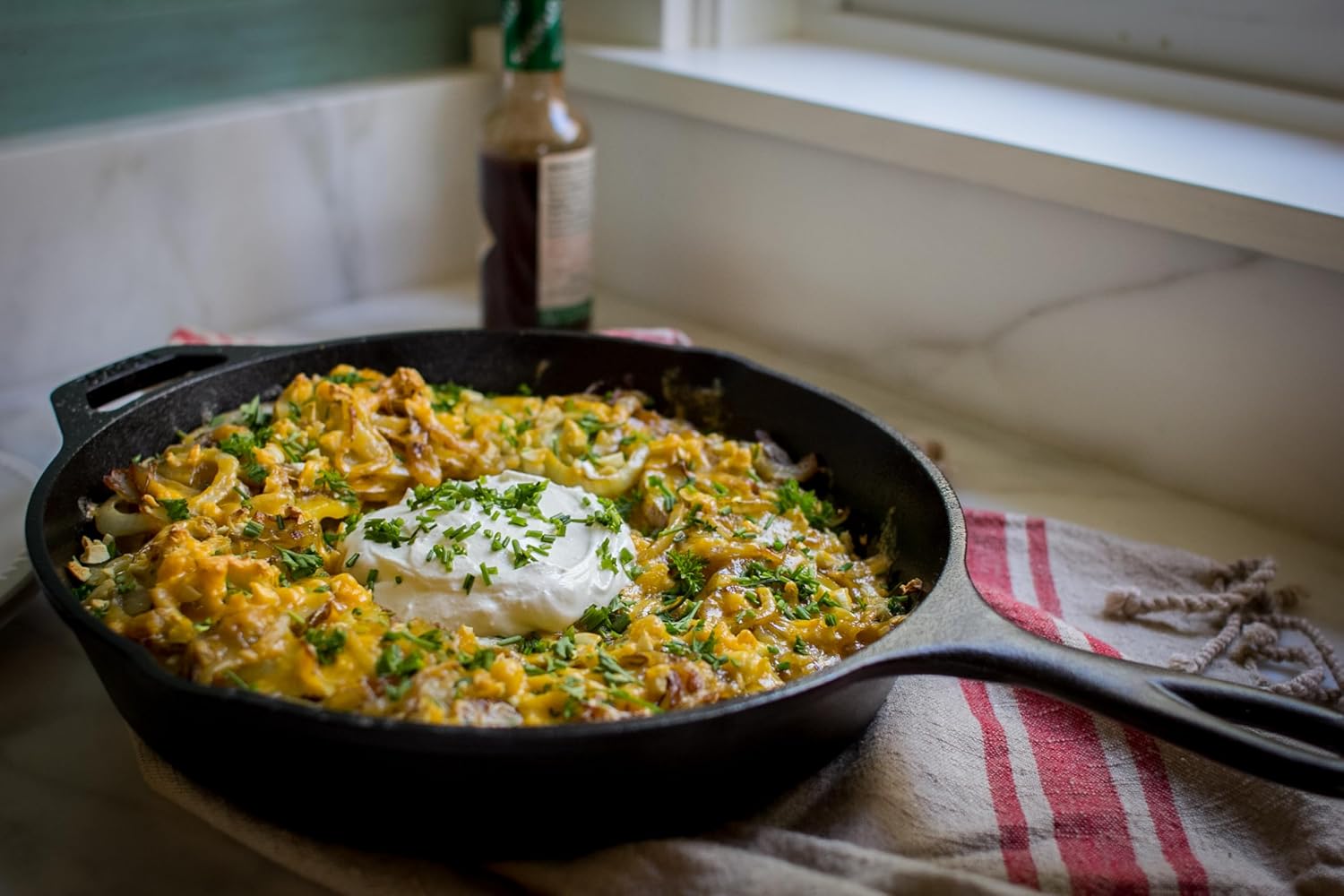
You’ve probably already heard that a cast iron skillet — a heavy, thick-walled pan made from molten iron poured into a mold — lasts essentially forever and gets better with use. That part is true. What’s less clear is why some cast iron costs $35 and some costs $300, and whether spending eight times more gets you eight times the pan. Cast iron, unlike most cookware, has been made by roughly the same process for over a century, so the price spread isn’t driven by fundamentally different technology. It’s driven by manufacturing tolerances, surface finish, weight distribution, handle geometry, and — honestly — branding. This guide breaks down every tier from Lodge to Lancaster and tells you, clearly, where the premium actually changes how the pan cooks and where you’re paying for aesthetics and origin story.
| EDITOR'S PICKLe Creuset Enameled Cast Iron S… | Mid-tierLodge Cast Iron Set - 5-Piece S… | Budget pickLodge Seasoned Cast Iron Skille… | |
|---|---|---|---|
| Size (diameter) | 11.75" | — | 10.25" |
| Material | Enameled cast iron | Cast iron | Cast iron |
| Pieces included | 1 | 5 | 1 |
| Pre-seasoned | — | ✓ | ✓ |
| PFAS-free | — | ✓ | ✓ |
| Price | $253.99 | $99.90 | $23.85 |
| See on Amazon → | See on Amazon → | See on Amazon → |
The Baseline: What Lodge Gets Right (and What It Doesn’t)
Lodge, the Tennessee-based manufacturer that’s been casting iron since 1896, is the undisputed reference point for the category. Their 12-inch Cast Iron Skillet retails around $35–$45 depending on retailer and season, and it is genuinely excellent cookware by any functional standard. Wirecutter has named Lodge a top pick repeatedly, citing its consistent performance, wide availability, and the simple logic that it behaves exactly like more expensive cast iron once it’s properly seasoned. Serious Eats echoes this — Kenji López-Alt’s guidance has long been that the Lodge performs comparably to pans costing three to five times as much for most cooking tasks.
Here’s what Lodge does well: it holds heat aggressively, survives temperatures that would warp lesser pans, moves from stovetop to oven without complaint, and builds a usable non-stick seasoning (a layer of polymerized oil that bonds to the iron surface) over months of regular cooking. It’s also induction-compatible, which matters as induction ranges now represent a growing share of new range purchases in 2026.
Here’s the honest knock: Lodge pans are machine-finished but not hand-polished. The cooking surface has a slightly pebbly, sand-cast texture rather than the glassy smoothness of older or more expensive cast iron. This texture is largely irrelevant once seasoning builds up — and owners report that after six months of regular use, the practical difference narrows significantly — but out of the box, eggs are more likely to stick on a Lodge than on a vintage Griswold or a polished modern pan like the Lancaster or Field Company. The other legitimate complaint is weight. Lodge’s 12-inch comes in around 8 lbs, and the handle angle, while functional, isn’t ergonomically exceptional.
Who should buy Lodge: Anyone who wants a workhorse skillet and doesn’t want to overthink it. First apartment, first cast iron, gift for someone who asks what to do with it — Lodge is the answer every time.
The Middle Tier: Field Company, Stargazer, and Butter Pat
The $100–$180 range is where things get genuinely interesting — and where the tradeoffs become real decisions rather than obvious ones.
Field Company No. 8 (~$135): Field makes a lighter, thinner-walled cast iron (their No. 8 is roughly 20% lighter than the comparable Lodge) with a machine-smoothed cooking surface. The weight reduction is meaningful if you’re cooking for one or two people and lifting the pan frequently. Owners consistently report that the lighter build and smoother surface make it noticeably easier to work with straight out of the box. The tradeoff: thinner walls mean slightly less thermal mass — less ability to hold a searing temperature when cold protein hits the pan. For searing a thick steak, Lodge arguably wins on raw performance. For everyday eggs, sautéed vegetables, and one-pan dinners, Field’s ergonomics are a genuine upgrade.
Stargazer 10.5-inch (~$105): Stargazer’s differentiator is a long, comfortable handle with a slight upward pitch that keeps your knuckles clear of the stovetop — a small thing that owners consistently call out as a daily-use improvement. The cooking surface is also machine-smoothed. Cook’s Illustrated has noted that handle design is one of the most underrated factors in cast iron usability, and Stargazer clearly engineered around it.
Butter Pat Industries (~$145–$200): Butter Pat markets itself on thin-cast, smooth-surface cast iron with an heirloom finish. Reviewers at Bon Appétit rate it highly for its immediate out-of-box performance and note that the polish reduces the break-in period meaningfully. The pan is made in the U.S., which factors into the price.
By the numbers:
| Pan | Weight (12-inch equiv.) | Surface finish | Price | Induction-ready |
|---|---|---|---|---|
| Lodge 12” | ~8.0 lbs | Textured (as-cast) | ~$40 | Yes |
| Field No. 10 (12-inch equiv.) | ~5.5 lbs | Machine-smoothed | ~$165 | Yes |
| Stargazer 10.5” | ~5.7 lbs | Machine-smoothed | ~$105 | Yes |
| Butter Pat 11” | ~4.8 lbs | Hand-polished | ~$195 | Yes |
The price-to-performance logic in this tier: you’re paying for ergonomics, surface smoothness, and reduced break-in time. If you cook on cast iron daily, the quality-of-life improvements are real. If you pull it out twice a week for searing and braising, you will not feel the difference enough to justify the premium over Lodge.
The Premium Tier: Lancaster and Finex
At $175–$250, you’re in what food content creators and supper-club hosts tend to consider the “considered purchase” zone — pans that are also aesthetic objects in a well-curated kitchen.
Lancaster No. 8 (~$175): Lancaster, a Pennsylvania-based maker, produces what reviewers consistently describe as the closest modern analog to vintage pre-WWII Griswold and Wagner cast iron — the kind your grandmother’s pan was, before mass manufacturing prioritized speed over surface finish. The cooking surface is exceptionally smooth, the weight is reduced relative to Lodge, and the design is visually minimal in a way that reads as intentional rather than industrial. Food & Wine has highlighted Lancaster specifically for buyers who want the performance of vintage cast iron without the uncertainty of buying old cookware at antique stores (where you can’t verify integrity or seasoning history).
Finex 12-inch (~$200–$250): Finex is the design-forward option — octagonal shape, coiled stainless steel handle that stays cooler longer than cast handles, and a polished surface. Owners report the handle is a genuine functional feature rather than just a styling choice; the spring coil conducts less heat than solid iron, so it’s usable on stovetop without a cloth for longer periods. The octagonal shape has partisans (more drip edges for pouring off liquid) and skeptics (harder to season evenly). Bon Appétit editors have included Finex when discussing cast iron that works as both a cooking tool and a kitchen display piece.
Who should skip the premium tier: If your primary use case is searing proteins, making cornbread, and braising short ribs — functional, high-heat cooking where thermal mass is an asset — Lodge or Stargazer does 95% of what Lancaster does. The premium buys you surface smoothness and origin story. If you’re cooking eggs daily on cast iron and you care about the look of your stovetop, Lancaster is a genuine upgrade.
Vintage Cast Iron: The Wildcard Tier
No guide to this category is honest without addressing vintage. Pre-1960 Griswold, Wagner, and Birmingham Stove & Range pans — found at estate sales, antique shops, and occasionally on resale markets — are thinner-cast, smoother-surfaced, and lighter than most modern cast iron. Serious Eats has noted that vintage cast iron is often the performance benchmark that modern premium makers are trying to reach.
The catches: condition varies wildly, rust and pitting require restoration work, and prices at antique shops have risen significantly as cast iron’s popularity has grown — a clean vintage Griswold 10-inch now commonly sells for $60–$120, erasing the obvious value advantage it once held. Wirecutter’s guidance is that vintage is worth pursuing if you enjoy the restoration process or stumble across a clean piece at a fair price, but it’s not a reliable or repeatable purchasing path for most cooks.
The Decision Frame
Here’s the actual tradeoff map:
If you want one pan that does everything and you don’t want to think about it: Lodge 12-inch. Full stop. It’s the most field-proven, widely available, and honestly-reviewed cast iron at any price. Every dollar above $40 in this category is incremental improvement, not transformation.
If you cook on cast iron four or more times a week and handle ergonomics matter to you: Stargazer or Field Company. The weight reduction and smoother surface are quality-of-life improvements you’ll actually feel. Stargazer’s handle geometry is the single most underrated feature in the mid-tier market.
If you want the best modern analog to vintage cast iron and you’re comfortable spending $175: Lancaster No. 8. Reviewers and owners consistently place it at the top of the modern category for cooking surface quality and design restraint.
If you want cast iron that also functions as a kitchen aesthetic statement: Finex for its design-forward visual language, or Lancaster for its minimal, heirloom look. Both are serious cooking tools that also read as intentional choices in a well-curated kitchen.
If you see a clean vintage Griswold under $60: Buy it. Restore it if needed (electrolysis rust removal is well-documented by the cast iron community and requires minimal equipment). It will likely outperform everything in this guide on surface smoothness.
The honest verdict: cast iron’s price ceiling exists mostly for ergonomics, aesthetics, and surface finish — not for heat retention or longevity, where the $40 Lodge is genuinely on equal footing with a $250 Finex after a year of seasoning. The premium is real but narrow. Know which version of “better” you actually care about, and spend accordingly.