You’ve heard the pitch before: carbon steel is basically cast iron, but lighter and faster. Both are true. But here’s the part the enthusiast forums understate — carbon steel is finicky in a way cast iron isn’t, and the gap between a great carbon steel skillet and a mediocre one shows up fast, right around the third time you try to sear a duck breast and watch the seasoning peel in patches. Carbon steel (an iron alloy with roughly 1% carbon, compared to cast iron’s 2–4%) is thinner, more responsive to heat changes, and capable of developing a genuinely slick cooking surface if you season it correctly. It also warps more easily, takes longer to build a reliable seasoning baseline, and varies more dramatically in quality from manufacturer to manufacturer. This guide is about navigating that variance: which pans are actually worth the 6-to-12-week seasoning investment, which ones you should skip, and how to match the right pan to how you actually cook.
| EDITOR'S PICKMauviel M'Steel Black Carbon Na… | Mid-tier[de Buyer MINERAL B Carbon Steel…](https://www.amazon.com/dp/B00NSHWEHE?tag=greenflower20-20) | Budget pick[Lodge Seasoned Carbon Steel Ski…](https://www.amazon.com/dp/B005U93RYW?tag=greenflower20-20) | |
|---|---|---|---|
| Diameter | 11 inch | 12.5 inch | 12 inch |
| Cooking surface | — | 9 inch | — |
| Handle material | Iron | — | Long handle |
| Country of origin | France | France | — |
| Seasoned | — | — | ✓ |
| Price | $120.00 | $100.00 | $49.99 |
| See on Amazon → | See on Amazon → | See on Amazon → |
What Makes One Carbon Steel Pan Different From Another
The short answer: gauge, steel quality, and handle geometry. The long answer involves some tradeoffs that matter more than the marketing copy suggests.
Gauge (thickness). Most consumer carbon steel pans fall between 2mm and 3mm thick. Thinner pans heat faster and respond more quickly when you reduce the flame — useful for a home cook who’s moving between high-sear and gentle-finish cooking. Thicker pans hold heat longer and are less prone to warping under thermal shock (the enemy of a pan you pull from a 500°F oven and set on a cool counter). Serious Eats’ review of carbon steel skillets by Sho Spaeth notes that pans in the 2.5–3mm range tend to be the sweet spot for home cook use — fast enough to be practical, thick enough to resist warping over years of use.
Steel origin and consistency. This is the variable most buyers can’t evaluate before purchase, but reviewers and long-term owners consistently report it through a proxy: how evenly does the pan season? A pan with inconsistent steel composition will develop hot spots, and those hot spots will show up as uneven seasoning — dark in some areas, dull gray in others. Cook’s Illustrated’s testing notes on carbon steel repeatedly surface this issue with lower-tier imports, where the steel spec is less controlled.
Handle design. Carbon steel handles run hotter than cast iron handles because the pan is thinner and conducts heat more efficiently along the whole piece. A long, slightly angled handle — like the classic French design used by de Buyer and Matfer Bourgeat — keeps your hand further from the heat source and gives you leverage for tossing. A stubby, welded handle (common on cheaper pans) transfers heat faster and gives you less control. If you plan to use the pan on induction, also check whether the handle geometry lets you slide the pan without lifting — induction cooktops are unforgiving to pans that tilt and lose contact with the surface.
The Pans Worth Knowing (and the Tradeoffs Each One Carries)
Matfer Bourgeat Noir Carbon Steel — The Benchmark
The Matfer Bourgeat Noir is the pan Wirecutter has consistently named as their top pick for carbon steel, and the reasoning holds up across aggregated owner reviews: it’s French-made, stamped from a single piece of steel with no rivets (meaning no crevice for seasoning to fail around a rivet joint), and available in a wide size range from 8.6 inches to 15.75 inches. Owners consistently report that it seasons more evenly than any pan in its price class, and that after 6–8 months of regular cooking, the surface approaches the slickness of a well-maintained non-stick — without the PTFE degradation concern.
The tradeoff: the handle angle is polarizing. It’s nearly flat, which feels awkward if you’re used to the ergonomics of a Western skillet. It also gets hot fast. Budget roughly $55–$75 depending on size (as of mid-2026 pricing), which positions it as a buy-once-keep-forever value.
Best for: Cooks who want the most proven seasoning track record and don’t mind a learning curve on the handle.
de Buyer Mineral B — The Beeswax Seasoning Head Start
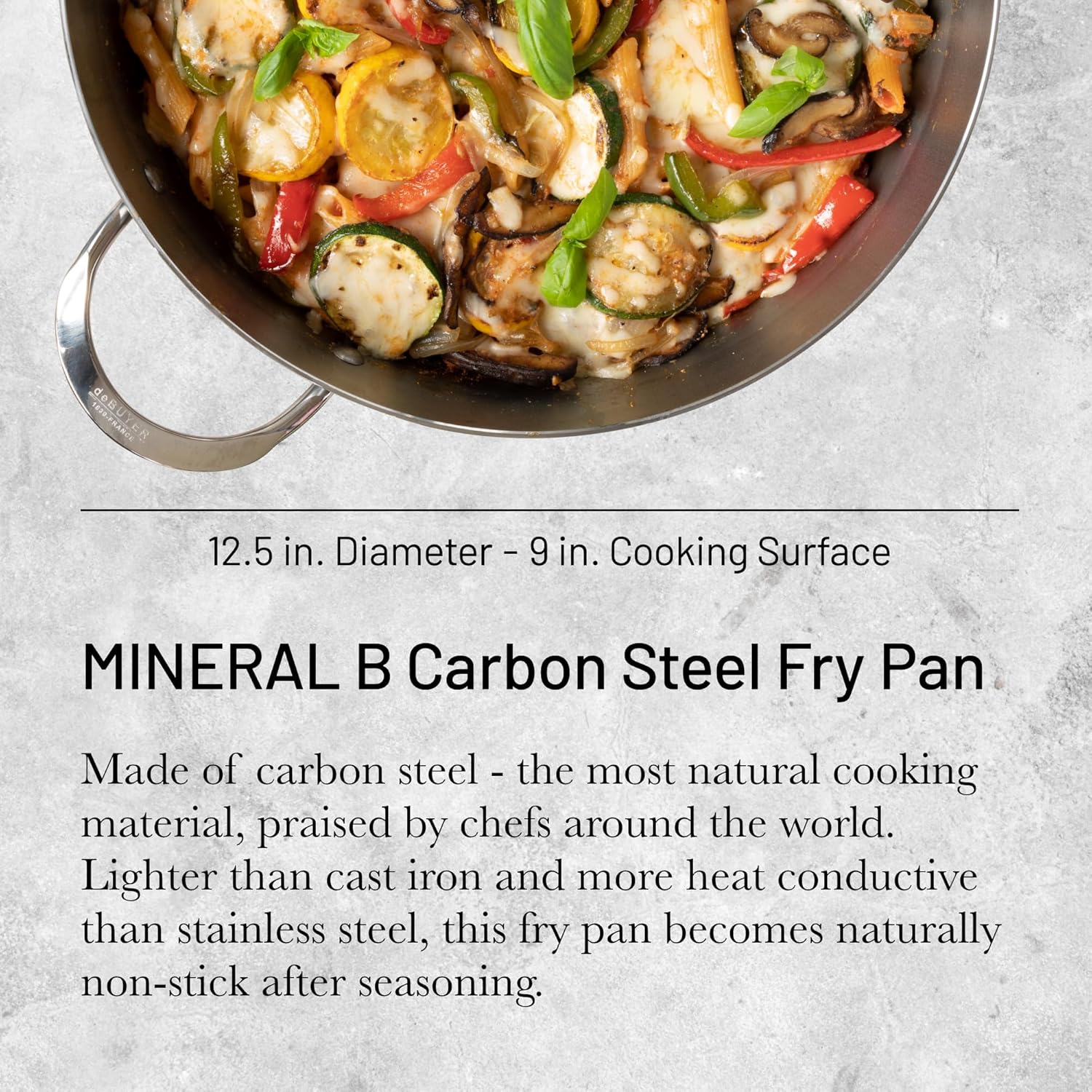
The de Buyer Mineral B comes factory-coated with beeswax, which gives you a partial seasoning out of the box and shortens the “break-in” period that discourages beginners. Bon Appétit has called it one of the best entry points into carbon steel for exactly this reason. The steel is also slightly thicker than the Matfer on comparable sizes, which owners note makes it more forgiving on high-heat induction burners.
The tradeoff: the rivet construction (the handle is attached via visible rivets) creates a small crevice that can trap residue. Long-term owners report it’s manageable with proper cleaning habits, but it’s a real consideration if you cook acidic foods frequently and are aggressive about build-up. Pricing runs $60–$95 depending on size.
Best for: Cooks who want a faster path to a usable surface and cook predominantly proteins and vegetables (not high-acid sauces).
Blu Skillet Ironware — The Artisan Option
Blu Skillet pans are handmade in Seattle, available only through the company’s website, and priced accordingly — a 10-inch pan runs around $200. The appeal is real: owners report exceptional heat distribution and a factory seasoning that’s noticeably more developed than mass-market alternatives. For design-conscious buyers who care about the visual language of their kitchen, the hammered finish and American provenance are part of the value proposition.
The tradeoff is obvious: $200 for a 10-inch skillet only makes sense if the artisan story and aesthetics are genuinely part of what you’re buying. On pure performance per dollar, the Matfer competes at less than half the price. Blu Skillet is a considered splurge, not a performance upgrade.
Best for: The design-conscious buyer for whom the pan is also a display object, or someone who actively wants to support domestic small-batch manufacturing.
Lodge Carbon Steel — The Accessible Starting Point
Lodge’s carbon steel line is the obvious entry point for someone who isn’t sure they’ll commit to the seasoning regimen. Wirecutter and Serious Eats both note that Lodge pans are pre-seasoned with vegetable oil (similar to their cast iron line) and priced at $45–$65, which makes the risk of a “wrong size” or “wrong handle shape” purchase less costly.
The tradeoff: the pre-seasoning is thin and uneven compared to what a de Buyer’s beeswax coating provides. Several owner reviews note visible rough texture from the casting process — Lodge uses a different manufacturing method than the French stamped pans — which can slow the development of a truly smooth cooking surface. It’s a good first carbon steel pan; it’s not the pan most cooks end up keeping for 20 years.
Best for: Cooks who want to try carbon steel before committing at a higher price point, or who need a beater pan for camping and outdoor cooking.
By the Numbers
| Pan | Approx. Price (10-in) | Gauge | Rivets? | Induction Compatible? |
|---|---|---|---|---|
| Matfer Bourgeat Noir | ~$65 | ~2.5mm | No | Yes |
| de Buyer Mineral B | ~$80 | ~2.8mm | Yes | Yes |
| Blu Skillet Ironware | ~$200 | ~3mm | No | Yes |
| Lodge Carbon Steel | ~$50 | ~2.5mm | Yes | Yes |
Pricing based on manufacturer and major retailer listings, May 2026.
The Seasoning Question Nobody Answers Honestly
Here’s the actual difference between carbon steel seasoning and cast iron seasoning: cast iron is forgiving because its thicker walls distribute heat slowly and the seasoning layer sits on a larger surface area. Carbon steel is thin enough that one mistake — overheating with the wrong oil, cooking a high-acid tomato braise before the seasoning is fully cured, or running it through a dishwasher even once — can strip you back to square one.
The regimen that consistent long-term owners describe, per aggregated reviews on Serious Eats and Cook’s Illustrated forum discussions, looks like this: thin layers of a high-smoke-point oil (flaxseed oil is controversial — many experienced cooks now report it chips; refined avocado or grapeseed is more reliable), wiped nearly dry before each oven seasoning session, at 450–500°F, for 45–60 minutes. Repeat 4–6 times before you cook anything sticky. Then cook bacon, sauté onions, fry potatoes — fatty, forgiving things — for the first few weeks. Save eggs and fish until the pan has 3–4 months of polymerized layers.
The pans that make this process easier are the ones with consistent steel and no rivet crevices, which is why the Matfer’s no-rivet construction matters beyond aesthetics.
Induction, Warping, and the Long Game
Induction compatibility is a hard yes for all carbon steel pans — the ferrous steel responds immediately to induction’s electromagnetic field. The real induction-specific issue is warping. Induction burners create very concentrated heat zones, and thin carbon steel pans can develop a slight warp (a concave or convex bow in the base) if heated too aggressively on high. Wirecutter’s testing notes on carbon steel pans call out this phenomenon specifically with pans under 2.5mm gauge.
The practical fix: start induction sessions on medium heat for the first minute, then increase. Don’t put a cold pan directly on a burner at maximum power. This habit extends the flat-bottom lifespan of any carbon steel pan on induction significantly, and it’s the same practice most professional kitchen cooks use when they move a cold pan from storage to a commercial burner.
The Decision Rule
If you’ve read this far, you’re probably not deciding whether to buy carbon steel — you’re deciding which one and whether the price jump is justified.
Here’s the framework:
-
If you want the most reliable long-term seasoning track record at a fair price: Matfer Bourgeat Noir in the 11-inch size. It’s the pan most cooks who’ve gone through two or three carbon steel trials end up keeping.
-
If you’re new to carbon steel and want a shorter break-in period: de Buyer Mineral B, especially if you cook primarily on induction and want the slightly heavier gauge for heat stability.
-
If budget is the primary constraint and you’re testing the format: Lodge Carbon Steel gets you into the game without a $70+ commitment. Accept that it may be a stepping-stone, not a forever pan.
-
If the pan is partly a design and craft purchase: Blu Skillet is a legitimate choice — just go in knowing you’re paying for the artisan story as much as the cooking performance.
The seasoning investment is real. The pan that makes it easier is worth paying for. Buy once, season right, and this is genuinely the last skillet you’ll need for high-heat cooking.